

What Is the Best Instagram Hashtag Strategy in 2026?
The best Instagram hashtag strategy for the current era is to use 5–8 highly relevant, tiered hashtags in your caption instead of 20–30 generic tags. Combine niche, mid-size, and 1–2 broad tags plus a branded hashtag, then rotate sets and track performance in your account Insights.
Instagram Hashtags in 2026: What Changed and How Many to Use
Hashtags remain a vital tool for discovery and sorting your content for the algorithm. They act like labels. They tell the app what your post is about. This helps it reach the right people.
Instagram uses hashtags to sort and file your posts. When you add a tag, you file your post into a digital library. The system shows your work to users who want to see those specific topics. The old habit of using 30 generic, high-volume tags often triggers spam filters. This limits your reach. Data shows that posts using 5–8 targeted tags perform better in terms of impressions than posts using large blocks of random tags. Put tags in the caption. This helps search more than comments. Yes, hashtags still matter, provided you move away from spammy patterns and focus on relevance.
Instagram suggests 3–5 strong tags. Many creators test up to 8. You should aim for a limited number of high-quality tags to maximize your reach.
| Content Format | Recommended Hashtag Count |
| Feed Posts | 5–8 |
| Reels | 3–5 |
| Stories | 0–2 |
Using fewer, focused tags looks natural. It helps avoid spam flags. It signals to the system that your content is high-quality and meant for a specific community rather than a broad, uninterested audience.
Try this for a travel post: 2 niche tags about your city or activity, 2 mid-size tags about travel tips, 1 broad tag like #Travel, and 1 brand tag. Keep every tag about the photo or video. Do not add random tags just to get more views.

The 2026 Hashtag System: Tiers, Steps, and Safe Use
A tiered approach ensures you reach different audience sizes while staying relevant to your core topic. Use this structure to balance your visibility:
- Tier 1 (Niche): Tags with 10K–500K posts. These offer the highest engagement because the audience is highly specific.
- Tier 2 (Industry): Tags with 500K–5M posts. This provides a balance between reach and audience interest.
- Tier 3 (Broad): Tags with 5M+ posts. Limit these to 1–2 per post to maintain a broad connection without being lost in the noise.
- Branded/Community: Always include your unique business or campaign tag to build brand identity.
The Formula: 2–3 Tier 1 + 2–3 Tier 2 + 1 Tier 3 + 1 Branded = 6–8 tags. Sample set (6 tags): two niche tags about your topic, two mid-size tags your audience follows, one broad tag, and your brand tag. Use this pattern on most posts.
Example for a small online store: two niche tags about your product type, two mid-size tags about your niche, one broad tag like #Shopping, and your store tag. Use English tags that your buyers type in search. This helps Instagram show your post to the right shoppers. For e-commerce brands in the US and UK, mix product tags with niche tags to reach your buyers.
To create your strategy, follow these steps:
- Define your content pillars: Identify 3–5 core topics you post about, such as digital marketing, travel, or fitness. Create specific hashtag groups for each pillar to ensure your tags match the subject.
- Research hashtags: Type your topic in the search bar. Pick tags with active recent posts. Avoid tags with hundreds of millions of posts. Your post will get lost there.
- Analyze competitors: Look at accounts in your field that get high saves and shares. Note the recurring tags they use, but only adopt them if they fit your style.
- Build rotating sets: Never use the same set of tags for every post. Create separate sets for each of your content pillars and rotate them to keep your discovery fresh.
- Test and track: Wait one day. Open Post Insights. Check “From Hashtags.” If a tag shows zero views on many posts, remove it. Add a new, closer tag. Many creators use this method to keep growth steady.
Instagram reads the caption first for search. To keep your post looking neat, add 3–5 line breaks at the bottom of your caption to separate the hashtags from your main message.
Using banned hashtags can lead to “shadowbanning,” where your posts are suppressed and reach is significantly reduced. To stay safe, search for any tag you plan to use; if the “Recent” tab is hidden or a warning appears, do not use it. Check your core list every 4–8 weeks, as tags can become restricted at any time.
Apply It: Content Types, Mistakes, and Quick Wins
- Feed Posts: Use 5–8 tags using the tiered formula. This remains your best opportunity to rank in search results.
- Reels: Use 3–5 tags. Reels rely heavily on the interest graph, so tags should be highly niche to help the algorithm find the right viewers quickly.
- Stories: Use 0–2 tags. Stories disappear fast. Hashtags here give very small reach. Only include them if you want to be indexed in a specific public Story feed.
Creators in English-speaking markets often use 5–8 tags in captions. If you sell to US or UK buyers, include tags they use daily. This helps local discovery.
For coaching or service posts, use 2 niche tags about your offer, 2 mid-size tags about your niche, 1 broad tag like #Business, and 1 brand tag. Keep the same 6–8 tag pattern on most posts. Change only the niche tags to match each new topic.
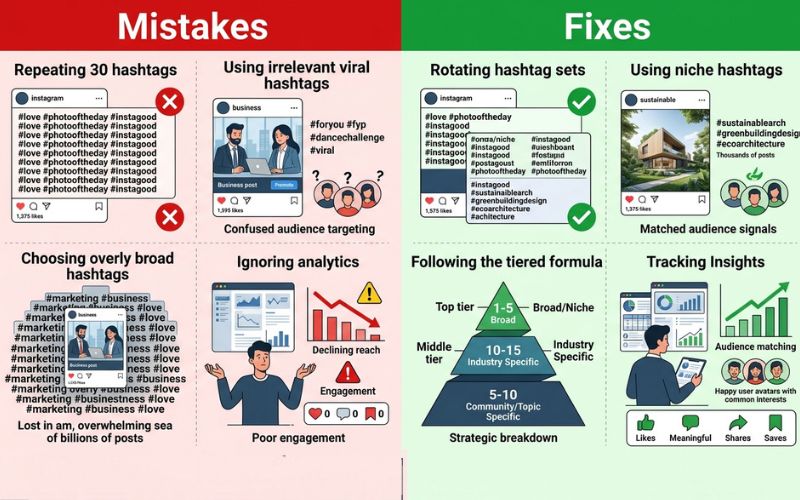
Common mistakes include:
- Repeating the same 30 tags: You look like spam. Fix: Rotate 3–5 sets instead.
- Using huge, general tags: Your post gets buried. Fix: Focus on niche and mid-size tags.
- Using unrelated viral tags: This confuses the algorithm. Fix: Only use tags that directly describe the visual or the caption.
- Never checking performance: You waste time on dead tags. Fix: Review “From Hashtags” in Insights and remove underperforming tags.
Before: 30 big tags like #Love and #Explore. After: 6 focused tags about your post topic and audience.
For every new post, use this formula to stay on track:
2–3 Niche + 2–3 Mid-size + 1 Broad + 1 Branded = 6–8 tags.
The Final Verdict on “Best Instagram Hashtag Strategy for 2026”
Success on Instagram depends on fewer, smarter, and tiered hashtags rather than large, random blocks. By using 5–8 relevant tags in your captions, rotating your sets, and regularly auditing your performance, you can increase your reach significantly. Audit your last 9 posts today. Drop any tag that shows zero impressions and rebuild your sets using the tiered formula. Test this approach on your next 5 posts to see the improvement in your reach.
FAQs: Instagram Hashtag Strategy
What is the best Instagram hashtag strategy in 2026?
The best strategy is using 5–8 targeted, tiered hashtags in the caption that directly describe your content and audience.
How many hashtags should I use on Instagram posts and Reels?
Use 5–8 for Feed posts and 3–5 for Reels to ensure optimal indexing without looking like spam.
What is the 3-3-3 or 5-3-1 hashtag rule?
This is a simplified version of the tiered approach, suggesting 5 niche, 3 mid-size, and 1 broad tag. It is a great starting point for beginners.
Are hashtags useless on Instagram now?
No, hashtags are still essential for search and discovery, but they must be used for relevance rather than volume.
How do I find the best hashtags for my niche?
Use the Instagram search bar to find relevant tags with manageable post counts and look at the “Related” tags feature. Type your main topic in the search bar. Pick tags with active recent posts and clear meanings. Avoid tags that are too big or too vague.
How often should I change my hashtag sets?
Rotate your sets with every post or every few posts to keep your reach fresh and signal new relevance to the algorithm. If a tag shows very low views for 3–4 posts in a row, swap it out. Keep the tags that bring steady views and saves.
You May Also Like:
Instagram Shadowban: Causes, Signs, and Fixes
Information About Foxtpax Software: 2026 Complete Guide
Disclaimer
This article is for informational and educational purposes only and does not constitute professional advice. We are not responsible for any changes in social media platform algorithms or account performance. Some images used are AI-generated for illustrative purposes. All trademarks and copyrights belong to their respective owners. Please use these strategies at your own discretion.

Eleanor Karen is an administrator at PVStory.co.uk who writes about digital tools, social media trends, and online resources. She shares helpful insights on Instagram Story Viewer tools and other web-based solutions, helping readers stay informed and make the most of their online experience.